
CaféScientifique is a nationwide network of groups for the informal discussion of scientific issues
The next meeting is on
Tuesday 10 November 2026
at 7.00pm at Eagle House Hotel
3, Castle Street,
Launceston PL15 8BA
PLEASE NOTE THIS TALK WILL NOT BE LIVE STREAMED
Professor Steven Rowland
Professor Emeritus University of Plymouth
“Fools' Gold or Floating Gold:
A story of ambergris”
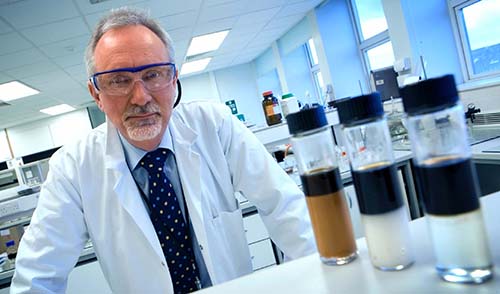
For centuries, and possibly for millenia, humans have coveted a strange, rare material occasionally washed up on shorelines all over the world as jetsam, including sometimes on Cornish beaches. It is called ambergris and sometimes known as ‘floating gold'. What really is this substance; why is it valued; where does it come from, and can it be identified scientifically? This talk describes how chemists from the University of Plymouth set about trying to answer these questions by a combination of historical research and chemical analysis.
Steven Rowland is Professor emeritus at the University of Plymouth, Adjunct Professor at Curtin University, Western Australia, and formerly Honorary Professor at the University of Exeter and Blaustein Fellow at Stanford University, USA. He was a European Research Council (ERC) Advanced Investigator from 2009-2014 and received a €2,000,000 research award from the ERC for his work on marine pollution. He has studied pollution events at sea for over 45 years and in 2021 was a co-recipient of the Queen's Anniversary prize awarded at Buckingham Palace for his research into microplastics in the sea. Since retirement aged 65 in 2019 Steve has continued to pursue his scientific interest in jetsam ambergris, along with colleagues at Plymouth, Australia and in Spain. He has published over 250 research papers including in 2026, the most cited nearly 9000 times. He has been Chair of Café Scientifique Launceston since 2023 and his last lecture to Café Scientifique was on Valentine's Day 2023.
2025 CaféScientifique Young Scientist of the Year - Results
2025 CaféScientifique Young Scientist of the Year Competition |
|||
Winner |
Abi Fraser |
Ancient Viruses within the Human Genome |
Launceston College |
Joint Runner up |
Freya Tonks |
Could you next Dental Check-up save your Life? |
Bideford College |
Joint Runner up |
Florence Castleden |
Ten Thousand Broken Lightbulbs: the Science of Creativity |
Liskeard College |
2025 CaféScientifique Young Scientist of the Year Competition – Members' Choice |
|||
Winner |
Abi Fraser |
Ancient Viruses within the Human Genome |
Launceston College |
Runner up |
Florence Castleden |
Ten Thousand Broken Lightbulbs: the Science of Creativity |
Liskeard College |
Entries
|
|
|
Ancient Viruses within the Human Genome |
|
Have Black Holes affected Our Understanding about the Early Universe ? |
|
Putting the Mouth back in the Body |
|
Defence & Disorder: understanding Immunity & Autoimmune Diseases |
|
Animal Abilities |
|
How mobile phone bans impact pupils' education and wellbeing in secondary schools |
|
Ten Thousand Broken Light Bulbs: The Science of Creativity |
|
Climate change tipping points: how close are we to irreversible disaster? Matthew Carr Bideford College |
|
|
Judges
Chair: Professor Steve Rowland FRSC C Chem
Professor Colin Webb MBE FRs
Professor Michael N. Moore, BSc (Hons), PhD, FRMS
Dr Alan Malvern MA D Phil M Inst P C Phys AFHEA
Marion McCullagh MVB MRCV
Meg Walker BSc Microbiology and Genetics London PGCE
Dr Alan Whittle
CaféScientifique,Launceston
Young Scientist of the Year 2025 Competitions
Tuesday 8 July 7.00pm
Eagle House Hotel, 3 Castle Street, Launceston PL15 8BA
RULES
There are only 2 competitions this year:
2025 Young Scientist of the Year
2025 Young Scientist of the Year - Members' Choice
It is essential to read the Annexe below with the rules of each competition
2025 Young Scientist of the Year
Entrants to this competition are automatically considered for the the Members' Choice Competition
RULES
1. Object of the CaféScientifique, Launceston Young Scientist of the Year Competition
To give young people aged 15 years or over in full time education studying in local secondary schools (entrants) the opportunity to prepare and present a talk (presentation) on a science or engineering related topic of their choice to the members of CaféScientifique, Launceston (CaféSci) thereby competing for the title of CaféScientifique, Launceston Young Scientist of the Year (competition) normally at its July meeting.
2. Date of Competition
The date of the competition shall be determined by the committee.
3. Rules of Competition
i. The rules of the competition (rules) are set out in clauses 4 - 7 below as amended by the Annexe 2025 (Annexe)
ii. The committee of CaféSci (committee) may change the rules as necessary at a committee meeting.
4. Presentation
i. Each entrant's presentation shall be the result of their own work and research, but they may be mentored under the local “Aspire” programme or any similar scheme.
ii. The topic of the presentation must be finalised and communicated to the CaféSci Chair not less than two weeks before the date of the competition as set out in the Annexe.
iii. No presentation shall be longer than 10 minutes. Longer presentations will be marked down.
iv. All presentations are to be made in person.
5. Judges
i. A board of independent judges (judges) appointed by the committee will judge the competition.
ii. The judges' decision shall be final.
6. Results
The results will be announced at the meeting or as soon as possible thereafter to the entrants and on the News page of the CaféSci website www.cafescilaunceston.org
7. Prizes
i. Money prizes as agreed by the committee and certificates will be awarded to a winner and a runner-up in each category as set out in the Annexe
ii. A Certificate of Participation in the competition will be awarded to all other entrants.
ttachment:
Annexe 2025 see below
2025 Young Scientist of the Year - Members' Choice
RULES
1. Object of the CaféScientifique, Launceston Young Scientist of the Year Competition - Members' Choice Prize
To give members of CaféScientifique, Launceston (CaféSci) an opportunity to vote for a winner and runner-up in the above competition (competition) (rules annexed) to show their appreciation of the effort made by the entrants, normally at the July meeting (meeting)
2. Date of Competition
The date of the competition shall be determined by the committee.
3. Rules of Competition
i. The rules of the competition (rules) are set out in clauses 4 - 7 below as amended by the Annexe 2025 (Annexe)
ii. The committee of CaféSci may change the rules as necessary at a committee meeting.
4. Members
i. A member of CaféSci email list at the time of the competitions is a member for the purpose of voting.
ii. Only members present at the meeting may vote.
5. Voting
Members shall vote for one winner and one runner up in the competition
6. Results
The results will be announced at the meeting or as soon as practicable thereafter to entrants and on the News page of the CaféSci website www.cafescilaunceston.org
7. Prizes
Money prizes as agreed by the committee and certificates will be awarded to a winner and a runner-up in the competition as set out in the Annexe.
Attachments
Annexe 2025: see below
Annexe 1: Young Scientist of the Year Competition Rules: see above
ANNEXE
Forms part of the rules for both competitions
1. Object of this annexe (Annexe)
i. This Annexe may be changed by the Committee (committee) of CaféScientifique, Launceston (CaféSci) at any time prior to its publication to potential entrants for any given year.
ii. This Annexe forms part of the rules (rules annexed) for each of the above competitions (competitions) for the year 2025
2. Date of Competitions
The date of the competitions shall be Tuesday 8 July 2025.
3. Entrants to the competitions for 2025
1. Entries for 2025 shall be invited from the following: Launceston College, Bideford College, Liskeard School & Community College, Tavistock Community College, Budehaven Community School, Saltash Community School, Sir James Smith's Community School Camelford, Callywith College Bodmin, Okehampton College and Callington Community College.
ii. All entrants do so with the explicit permission of their parent or guardian to allow their child's name and photograph to be used in newspaper articles and on the internet connected with reporting and promoting the competitions
4. Competition Closing Dates
Topics of talks for the Young Scientist of the Year Competition to the Chair, Professor S J Rowland s.rowland@plymouth.ac.uk to arrive no later than Monday 23 June 2025
5. Results
The results will be announced at the meeting or as soon as practicable thereafter to entrants, on the News page of the CaféSci website www.cafescilaunceston.org
6. Prizes
Money prizes agreed by the committee for 2025 are as follows:
Young Scientist of the Year: First prize £100.00 Second Prize £75.00
Members' Choice: First prize £50.00 Second Prize £35.00
Annexe 1: Young Scientist of the Year Competition Rules: see above
Annexe 2: Members' Choice Prize Rules: see above